


Which way now for Rail Accessibility under Labour?

Updated: Jul 26, 2025
A post on why we should all be concerned about the Labour government’s commitment to an accessible rail network.
Below is a list of the 50 stations selected for ‘Access for All’ (A4A) funding in May 2024 by the last Conservative government.
Aigburth
Ash Vale
Battle
Bellgrove
Bodmin Parkway
Bredbury
Bushey
Castle Cary
Chinley
Church and Oswaldtwistle
Colchester
Dalston Kingsland
Dorchester South
Dudley Port
Dumbarton Central
Esher
Falkirk Grahamston
Flowery Field
Gunnersbury
Hedge End
High Brooms
Inverurie
Kew Bridge
Kidbrooke
Leagrave
Ledbury
Marden
Maidstone West
Neath
Newton for Hyde
Port Sunlight
Raynes Park
Rock Ferry
Ruabon
Sileby
Shotton
Sleaford
Small Heath
South Croydon
Stamford
Stroud
Swanwick
Thirsk
Ulverston
Upminster
Walton
Whitchurch (Shropshire)
Wivelsfield
Wymondham
Yeovil Junction
If we look at the number of stations nominated for ‘Access for All’ (A4A) funding in previous Control Periods, financing for the railway is allocated in five-year Control Period (CP) blocks, then 50 stations is about average.
Control period 5 (2014-2019) had 42 stations nominated. Control Period 6 (2019-2024) had 73 stations nominated, with a further 12 added in the March 2020 budget.
Moving forward to December 2024, with a new government and the Labour Minister for Rail, Lord Hendy, tells the Commons Transport Committee that the 50 “was not really a list of 50 that were going to happen. It was a list of things that might be done if they proved to be feasible. We have to work our way through that.”
Moving further forward to June 2025 and we still await an announcement on these 50 stations, over a year on from the initial announcement.
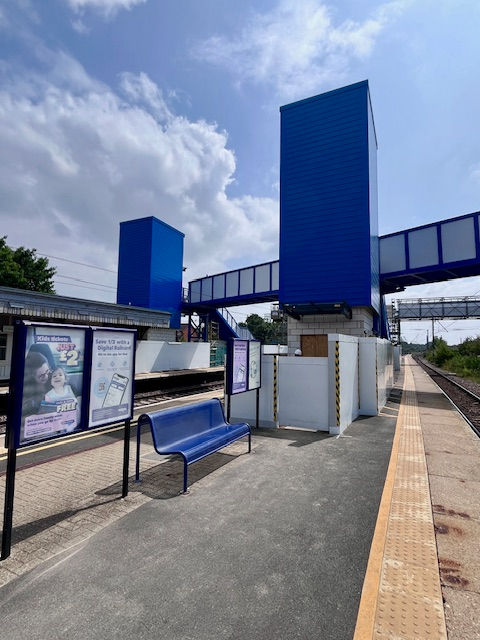
And in the case of Leagrave station, a station for which I have campaigned for step-free access alongside Sarah Owen MP for several years, an initial feasibility study, carried out by Network Rail, has already taken place. I know this because I successfully pitched to the local council for funding for the feasibility study.
At this point I should add that it was the current rail minister, Lord Hendy, the accountable minister for rail accessibility, who released the ‘Hendy Report’ in 2015 that resulted in the mothballing of 27 ‘Access for All’ projects in 2015 – some of which are still awaiting step-free access today. It would not be an unreasonable question to ask if we have the right leadership in charge to drive forward the change required to make our UK rail network accessible.
Currently, fewer than 2% of UK railway stations have level access between the train and the platform. Further, a government spokesperson admitted in a Westminster Hall debate on the 18th March 2025, that only 20% of stations across Great Britain have step-free access to and between all platforms.
In light of this, and bearing in mind that there are over 2,500 railway stations in the UK, if the current Labour government cannot even firmly commit to the 50 stations listed earlier, then what chance do we have of achieving an accessible rail network within many of our lifetimes? As Baroness Tanni Grey-Thompson noted: “In my lifetime, I will not be able to get on a train without the permission or support of a non disabled person.”
In the government’s recently announced June Spending Review, there was not a single mention of funding for rail accessibility.
Lord Hendy has announced the creation of an ‘Accessibility Roadmap’, due to be published later this year. While this is welcome, on current form, I have little confidence that it will do anything to shift the glacial rate of accessibility improvements across the UK rail network.
We have net-zero carbon targets set in law; we should have the same for a time-bound, funding ringfenced, accessible network too.
I have serious doubts that this will be achieved under the current leadership of the rail industry who have, by their own admission, failed disabled people.
It is particularly disappointing that this culture seems to be continuing under a Labour government, whose core values have traditionally been equality, social justice, a dynamic economy and more recently the drive to net zero.
And it is yet another example of this government punching down at the most vulnerable in our society. We can and must do better than this. It’s not just morally the right thing to do, it makes economic sense too.
Julian Vaughan
Chair Bedfordshire Rail Access Network
20th June 2025
Sources and Further Reading
House of Commons Transport Committee: Access Denied: rights versus reality in disabled people’s access to transport. https://committees.parliament.uk/publications/47122/documents/244036/default/
Association of British Commuters: Rail Accessibility: Department for Transport in breach of UN Disability Convention https://abcommuters.com/2025/06/16/rail-accessibility-dept-for-transport-in-breach-of-un-disability-convention/
Hansard: Stations Step-Free Access – Westminster Hall Debate 18th March 2025 https://hansard.parliament.uk/Commons/2025-03-18/debates/0E9C5C68-1541-4BC4-AC3C-218F313C152B/StationsStep-FreeAccess#
DPTAC Working towards a fully accessible railway https://www.gov.uk/government/publications/dptac-reference-frame-working-towards-a-fully-accessible-railway/dptac-reference-frame-working-towards-a-fully-accessible-railway
Julian Vaughan: A Decade of Step-Free delay https://julianvaughan.blog/2024/08/09/a-decade-of-step-free-delay/
Julian Vaughan: Step-Free and ‘Appendix B’ https://julianvaughan.blog/2024/11/15/step-free-and-appendix-b/
Comments